
2026 Biobased Surfactants: Short Course Description
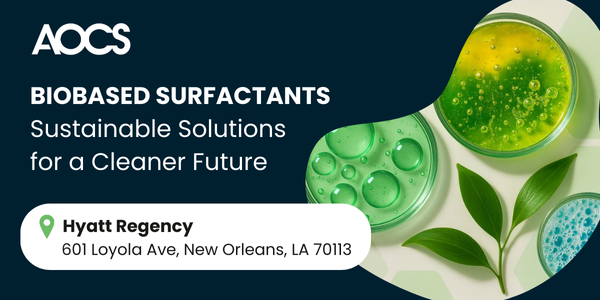
This in-person, two-day short course provides a clear, structured foundation in biobased and biosurfactant technologies, linking fundamental surfactant science with production pathways, formulation considerations, performance expectations, and regulatory drivers that influence today’s sustainable chemical and consumer products industries.
Designed for professionals across research and development, formulation, manufacturing, regulatory affairs, and sustainability functions, the program emphasizes practical understanding of renewable surfactant systems and the technical, economic, and environmental factors that shape successful development and scale-up.

Attendees will gain insight into:
- How biobased and biosurfactant systems differ from conventional petrochemical surfactants,
- How feedstock selection and production pathways impact performance and scalability, and
- How these considerations intersect with formulation, regulatory, and sustainability requirements across various end-use markets.
Across two days, the curriculum covers the full lifecycle of renewable surfactants—from fundamental structure and function through feedstocks, fermentation and chemical synthesis routes, formulation and production realities, environmental and toxicological evaluation, and industrial and consumer applications—while tying each topic to real-world decision-making.
The inclusion of case studies from established manufacturers and emerging innovators ensures participants leave with a practical understanding of the technical, economic, and regulatory factors shaping the adoption of biobased surfactants today.
Whether you work in research and development, formulation, engineering, manufacturing, regulatory affairs, sustainability, or organizational leadership, this course equips you with a deeper, more integrated understanding of biobased surfactant technologies and their implications for product performance, scale-up, compliance, and long-term portfolio strategy.
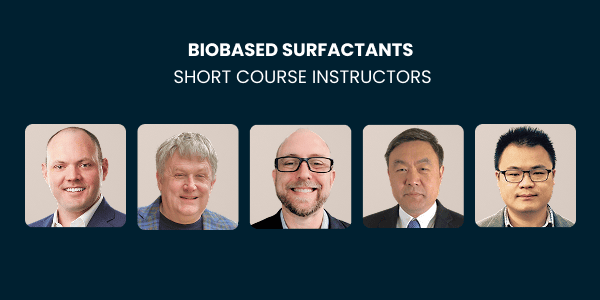
2026 Instructors
Ian Fleming
Senior Scientist Manager in Corporate R&D, Procter & Gamble, (United States)
Ian Fleming is a Senior Scientist Manager in Corporate R&D at Procter & Gamble where he leads upstream surfactant innovation at the intersection of chemistry and biology as well as the fermentation and bioprocess capabilities. He is dedicated to amplifying biotech innovations by enhancing educational opportunities, fostering professional growth, and championing collaboration across the industry.
Ian earned his Ph.D. in Microbiology from The Ohio State University and has over 11 years of experience in the biotechnology sector, including seven years at Guild Biosciences leading federally funded development of innovative biotechnological solutions, including antibody development, functionalized DNA origami nanostructures, and genetic engineering of bacteriophages. At P&G his work is aimed at enhancing P&G’s everyday products with bio-inspired and sustainable biotechnology solutions that are safe for humans and the environment.
Brian Grady
Professor and Douglas and Hilda Bourne Chair in Chemical Engineering; Director, Institute for Applied Surfactant Research
University of Oklahoma (United States)
Brian Grady is a Professor of Chemical Engineering at the University of Oklahoma, where he holds the Douglas and Hilda Bourne Chair and serves as Director of the Institute for Applied Surfactant Research, an industry-focused consortium supporting applied surfactant science. His work bridges fundamental research and practical industrial applications.
He earned his undergraduate degree in Chemical Engineering from the University of Illinois and began his career as a Project Engineer at Procter & Gamble before returning to academia to complete his graduate studies at the University of Wisconsin. Since joining the University of Oklahoma in 1994, Brian has maintained close ties to industry through research collaborations, consulting, and professional education. He is a principal at Surfactant Associates, which delivers advanced surfactant short courses and applied research projects for industry clients.
Lucas Moore
Vice President of R&D
Colonial Chemical, Inc. (United States)
Lucas Moore is Vice President of R&D and Regulatory Affairs at Colonial Chemical, Inc., where he leads the company’s global innovation, technical service, and regulatory strategy. His work focuses on the development and application of specialty surfactants for personal care, HI&I and car care, oil and mining, metalworking fluids, and related markets. He joined Colonial Chemical in 2022.
Lucas brings nearly 20 years of experience in the specialty chemicals industry, with prior roles at Arkema–ArrMaz, Kemira, and Ciba Specialty Chemicals. He is the author or co-author of more than 80 publications and conference presentations and is a co-inventor on more than 30 patent applications. He earned his doctorate in Organic Chemistry from the University of Alabama and completed postdoctoral research at the University of Arkansas, focusing on ligand design and organometallic chemistry.
Wanglin Yu
R&D/TS&D Fellow – Dow
Wanglin Yu is an R&D / TS&D Fellow in Dow’s Industrial Solutions (DIS) R&D. He has been working for Dow Chemical for 23 years and is currently responsible for product development focusing on surfactants and polyglycols, and related applications in Consumer, Industrial, and Energy sectors.
His innovations have resulted in commercial introduction of multiple novel surfactant products. He has over 60 publications in peer-reviewed journals and is an inventor/co-inventor of 40 granted patents. He received his PhD in Physical chemistry from Peking University in 1995.
Zhenyu (Jason) Zhang
Professor of Soft Matter Engineering
University of Birmingham (United Kingdom)
Jason Zhang is a Professor of Soft Matter Engineering in the School of Chemical Engineering at the University of Birmingham. His research focuses on controlling the physicochemical behavior of soft matter systems—including polymers, proteins, fibers, and bacteria at interfaces—to enable innovative and sustainable formulations.
His work emphasizes interfacial phenomena, structure–property relationships, and responses to external stimuli, with applications spanning surfactants, coatings, and formulation science. Jason serves as an Associate Editor for the Journal of Surfactants and Detergents and Frontiers in Coatings, Dyes and Interface Engineering. In 2023, he was awarded the McBain Medal by the Royal Society of Chemistry and the Society of Chemical Industry in recognition of his contributions to colloid and interface science.
Learning Objectives
By the end of this course, participants will be able to:
- Explain the fundamental structure, function, and classification of surfactants, including key differences between conventional and biobased systems.
- Describe how renewable feedstocks and molecular architecture influence surfactant performance, compatibility, and application suitability.
- Compare fermentation-based and chemically synthesized biobased surfactant production pathways and identify the advantages and limitations of each.
- Evaluate the roles of feedstock selection, processing conditions, and scale-up constraints in the manufacture of biobased and biosurfactants.
- Assess formulation considerations such as phase behavior, rheology, stability, and temperature sensitivity across ionic and nonionic surfactant systems.
- Interpret environmental and toxicological metrics, including biodegradability, ecotoxicity, and life cycle assessment, in the context of regulatory requirements.
- Identify regulatory frameworks affecting surfactant development and use, including key considerations related to REACH, EPA, and regional compliance.
- Recognize major classes of biobased surfactants, including alkyl polyglucosides, glycolipids, lipopeptides, and ester-based systems, and their industrial applications.
- Analyze case studies from established manufacturers and emerging companies to understand real-world performance, cost, and adoption challenges.
- Connect surfactant science and production principles to formulation strategy, product development, and cross-functional decision-making within industrial and commercial environments.
Learning Outcomes
After completing this course, participants will be able to:
- Map the full lifecycle of biobased and biosurfactant development, from feedstock selection and production through formulation, application, and regulatory evaluation.
- Select appropriate biobased surfactant systems based on performance requirements, formulation constraints, sustainability goals, and cost considerations.
- Assess technical, formulation, and environmental data to diagnose common performance or scale-up challenges and suggest targeted improvements.
- Reduce development risk by understanding the tradeoffs associated with fermentation-based and chemically synthesized surfactant pathways.
- Improve cross-functional communication by understanding the scientific, engineering, regulatory, and sustainability rationale behind surfactant selection and use.
- Support innovation and product development through a stronger understanding of interfacial behavior, molecular structure, and formulation dynamics.
- Understand regulatory and environmental requirements affecting surfactant commercialization, enabling better alignment with compliance and sustainability objectives.
- Evaluate application-specific surfactant considerations across industrial, home, and personal care markets.
- Make more informed technical and strategic decisions related to formulation performance, scalability, and portfolio development.
- Apply practical, industry-relevant knowledge immediately within research, formulation, engineering, regulatory, sustainability, or leadership roles.
Who Should Attend
This course is designed for professionals across the surfactant, oleochemical, and consumer products industries who need a clear, practical understanding of biobased and biosurfactant systems and their impact on formulation performance, scalability, regulatory compliance, and sustainability objectives. Whether your role is technical, commercial, operational, or strategic, this program strengthens your ability to evaluate surfactant technologies and apply that knowledge to product development, formulation optimization, portfolio planning, and organizational decision-making.
The course is especially relevant for individuals working in research and development, formulation, manufacturing, regulatory affairs, and sustainability who want to deepen technical knowledge, improve cross-functional communication, and stay current with evolving renewable feedstocks, production pathways, and regulatory expectations.
Participants will gain practical insight to evaluate biobased surfactant options, manage performance and cost tradeoffs, reduce development risk, and better understand the variables influencing successful adoption across industrial and consumer applications.
Roles that benefit include:
Technical & Research Roles:
-Research Scientists
-Formulation Scientists
-Applications Chemists
-Process Engineers
-R&D Managers
Operations & Production Roles:
-Manufacturing Engineers
-Production Managers
-Process Development Scientists
-Operations Managers
Business, Commercial & Strategic Roles:
-Product Managers
-Technical Sales Representatives
-Sustainability Program Managers
-Regulatory Affairs Managers
-Business Leaders and Executives
Location & Pricing
Non-Member: $1,250
AOCS Member: $950
AOCS Student Member: $500
All short course registrants receive a $200 discount on AOCS Annual Meeting registration (this discount excludes student, early career, retiree, and exhibit personnel pricing.) The short course will be held at the Hyatt Regency New Orleans | 601 Loyola Ave, New Orleans, LA 70113
Instructor(s)

Ian Fleming
Procter & Gamble, USA

Brian Grady
University of Oklahoma, USA

Lucas Moore
Colonial Chemical, Inc., USA

Wanglin Yu
Dow, USA

Zhenyu Zhang
University of Birmingham, UK
Registration & Access
The short course is not part of the AOCS Annual Meeting & Expo. It is a separate, stand-alone AOCS educational program that takes place before the annual meeting.
All short course registrants receive a $200 discount on AOCS Annual Meeting registration.* In addition, short course participants are invited to the AOCS Annual Meeting & Expo Welcome Reception on Sunday, May 3, beginning at 5:30 p.m. CDT (UTC−05). This reception features complimentary drinks and appetizers and offers an excellent opportunity to connect, network, and build relationships with peers from across industry, academia, and the global AOCS community—before the meeting officially begins.
*This discount excludes student, early career, retiree, and exhibit personnel pricing.
Related Resources & Education
Webinars
March 24, 2026
Know Before You Go! Maximize Your Time at the Annual Meeting
Preparing for the AOCS Annual Meeting & Expo With 80+ sessions, 500+ presentations, over 60 exhibitors, and a full schedule of networking events, the AOCS Annual Meeting & Expo offers a wide range of opportunities to learn and connect. For many attendees, the challenge isn’t finding something valuable—it’s knowing where to focus your time. Whether…
Webinars (On-Demand)
A Platform for Strain Development and Lipid Analytics: High-Volume Screening in Microalgae Fermentation
Learn how Checkerspot designed and implemented a fit-for-purpose, high-throughput lipid analytics platform to support its strain engineering programs.
Webinars (On-Demand)
Rotunda Sponsored Webinar: Tracking Edible Oil Quality with Magnetic Resonance On-Demand Webinar
Watch a focused webinar designed for scientists, quality teams, and producers across the food and edible oils industry. Learn how benchtop magnetic resonance is transforming routine and advanced oil analysis—bringing fast, actionable insights directly to the lab bench.