
2026 Edible Oils Refining: Short Course Description
This in-person, two-day short course offers a clear, structured foundation in modern refining, connecting essential unit operations with the performance, quality, and economic considerations that drive today’s edible oils and biofuel sectors. Designed for professionals across research, engineering, quality assurance, commercial teams, and organizational leadership, the program emphasizes practical understanding of refining workflows and the variables influencing product consistency, efficiency, and compliance.
New for 2026:
In 2026, this short course will welcome Gil Wang, Director of R&D at Bunge, whose expertise in contaminant mitigation and product development adds depth to the program’s focus on innovation, analytical rigor, and processing challenges. His perspective strengthens the course’s relevance for R&D scientists, QA specialists, technical engineers, and leaders overseeing product performance or operational risk.
This year also features an expanded module on Palm Oil processing, a timely addition given the course’s location in New Orleans—one of the U.S. Gulf Coast’s key import hubs for palm and other tropical oils, and a region central to the rapid growth of renewable diesel and sustainable aviation fuel (SAF) production.

Attendees will gain context around how crude palm oil behaves differently from other feedstocks, how refining pathways adjust for palm-specific impurities, and how these considerations intersect with downstream fuel manufacturing requirements.
Across two days, the curriculum covers the complete refining sequence—from seed preparation and extraction through degumming, neutralization, bleaching, deodorization, modification, and quality assessment—while tying each step to real-world decision-making. The inclusion of updated content on bio- and renewable diesel processing ensures participants leave with a comprehensive understanding of the technical, regulatory, and operational factors shaping today’s oil and fuel markets.
Whether you work in research, sales, engineering, quality, scientific roles, or executive leadership, this course equips you with a deeper, more integrated understanding of refining principles and their implications for product specifications, process optimization, innovation pipelines, and strategic planning.
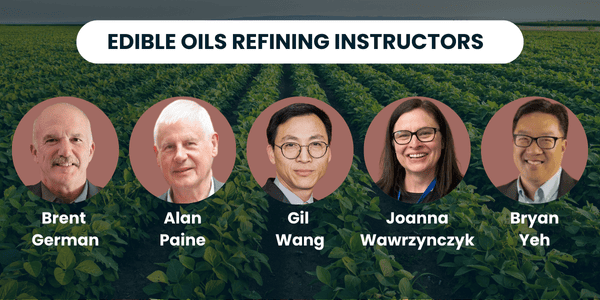
2026 Instructors
Brent German
Brent German has over 25 years of experience in engineering and process management within the fields of fats, oils, biofuels, and cellulosic sugars. His global expertise spans numerous countries, where he has contributed to optimizing processes such as chemical and physical refining, bleaching, and deodorization. With a deep understanding of refining workflows and operational parameters, Brent brings practical insights to help learners master refining techniques and process optimization.
Alan Paine
Alan Paine is an accomplished chemical engineer with extensive experience in vegetable oil refining. Over a 36-year career, he has developed expertise in refining processes such as degumming, fractionation, and neutralization. With a focus on practical applications, Alan’s teaching emphasizes refining process improvements and operational efficiency, empowering participants with strategies to optimize plant performance.
Gil Wang
Gil Wang received his education from Iowa State University. He is a specialist in edible oil refining and processing, with deep expertise in contaminant mitigation and product development. Over the past 20 years, he has led innovation across the industry, driving advancements in oil quality, safety, and functionality. His work bridges technical excellence with practical application, making him a trusted leader in the field.
Joanna Wawrzynczyk
Joanna Wawrzynczyk is a Senior Science Manager at Novonesis and is heading a laboratory of Oils and Fats Application Research in Denmark. She holds a PhD in Engineering from the Pure and Applied Biochemistry program at Lund Technical University in Sweden. Over the past twenty years, she has specialized in developing enzymatic processes for various industries such as water, wastewater, and pulp and paper. Since 2021, she has been focusing on biotechnological solutions for vegetable oils refining within the oils and fats industry. Joanna is passionate about solving chemical challenges using biotechnological tools. Originally from Poland, she currently works in Denmark and resides with her family in Sweden.
Bryan Yeh
Bryan Yeh brings over 35 years of experience spanning agribusiness, biofuels, and renewable energy. His expertise includes cold pressing, hydrogenation, and sustainable aviation fuel production, with a focus on integrating innovative techniques into refining practices. Bryan’s teaching provides participants with a comprehensive understanding of emerging technologies and their role in refining and sustainable production.
Course Sponsor
This program is sponsored by Clariant, a global leader in purification technologies and specialty additives.

Learning Objectives
By the end of this course, participants will be able to:
- Explain the fundamental steps in edible oil refining, from seed preparation and extraction through degumming, neutralization, bleaching, deodorization, and finishing.
- Describe the chemistry of crude oils and how impurities such as FFAs, phospholipids, pigments, and contaminants influence processing decisions.
- Compare refining methods (chemical vs. physical) and identify when each approach is appropriate based on feedstock characteristics and operational goals.
- Evaluate degumming, bleaching, and deodorization parameters to improve yield, product quality, and process efficiency.
- Interpret analytical quality measurements and understand their role in determining product specifications and commercial value.
- Identify common processing challenges and understand the operational and chemical factors that contribute to variability, loss, and off-spec conditions.
- Recognize the unique characteristics of palm oil and understand the refining adjustments required for palm-based feedstocks.
- Describe pretreatment needs for renewable diesel and SAF, including hydrotreatment requirements, contaminant thresholds, and catalyst protection.
- Apply biotechnological and enzymatic concepts to modern refining challenges (supported by new instruction from Dr. Gil Wang and Dr. Joanna Wawrzynczyk).
- Connect refining principles to plant-level decision-making, including optimization, troubleshooting, and economic considerations.
Learning Outcomes
After completing this course, participants will be able to:
- Map the full refining workflow and understand how decisions at each stage affect downstream operations and end-product quality.
- Select appropriate refining pathways based on crude oil composition, desired specifications, and cost/yield considerations.
- Assess process data and quality results to diagnose common issues and suggest targeted improvements.
- Reduce process losses through informed adjustments in pretreatment, degumming, neutralization, bleaching, and deodorization.
- Improve cross-functional communication by understanding the scientific, engineering, and operational rationale behind refining steps.
- Support innovation and product development through stronger understanding of contaminant behavior, modification techniques, and analytical requirements.
- Understand refining requirements for biofuel feedstocks, enabling better alignment with renewable diesel and SAF production needs.
- Evaluate palm oil refining considerations relevant to Gulf Coast imports and palm-based supply chains.
- Make more informed plant-level decisions related to process efficiency, specification management, and equipment performance.
- Apply practical, industry-relevant knowledge immediately within research, engineering, QA, sales, or leadership roles.
Who Should Attend
This course is designed for professionals across the edible oils, oilseed processing, and renewable fuels sectors who need a clear, practical understanding of refining operations and their impact on product quality, efficiency, and economic performance. Whether your role is technical, commercial, operational, or strategic, this program strengthens your ability to interpret refining principles and apply them to process optimization, specification development, innovation workflows, and organizational decision-making.
The course is especially relevant for individuals in research, sales, engineering, quality assurance, scientific roles, and executive leadership who want to deepen technical knowledge, improve cross-functional communication, and stay current with evolving technologies—including Palm Oil processing and renewable fuel pretreatment.
Participants will gain practical insight to refine processes, reduce loss, improve reliability, and better understand the variables influencing refined oil performance.
Roles that benefit include:
Technical & Research Roles:
-Research Scientists
-Lab Scientists
-Lab Managers
-QA Specialists
-Process Engineers
-R&D Managers
Operations & Production Roles:
-Plant Managers
-Plant Engineers
-Plant Operators
-Production Supervisors
Business, Commercial & Strategic Roles:
-Sales Managers
-Technical Sales Representatives
-Supply Chain Managers
-Business Managers
-C-Suite Executives
-Owners and Organizational Leaders
Location & Pricing
Non-Member: $1,250
AOCS Member: $950
AOCS Student Member: $500
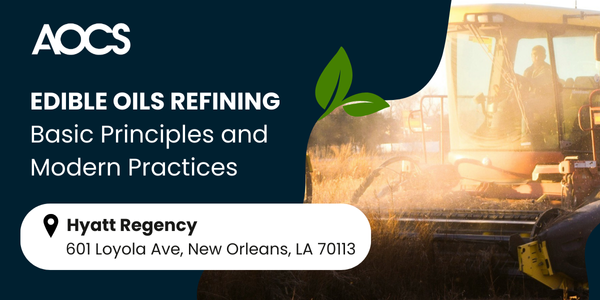
All short course registrants receive a $200 discount on AOCS Annual Meeting registration (this discount excludes student, early career, retiree, and exhibit personnel pricing.) The short course will be held at the Hyatt Regency New Orleans | 601 Loyola Ave, New Orleans, LA 70113
Instructor(s)

Brent German
Technical Consultant
Blind Corner Solutions LLC, USA

Alan Paine
Consultant
ARP Lipids Consulting, United Kingdom

Gil Wang
Director of R&D
Bunge, USA

Joanna Wawrzynczyk
Senior Science Manager
Novonesis, DK

Bryan Yeh
VP, Engineering and Operations
Canary Renewables, USA
Registration & Access
The short course is not part of the AOCS Annual Meeting & Expo. It is a separate, stand-alone AOCS educational program that takes place before the annual meeting. All short course registrants receive a $200 discount on AOCS Annual Meeting registration.* In addition, short course participants are invited to the AOCS Annual Meeting & Expo Welcome Reception on Sunday, May 3, beginning at 5:30 p.m. CDT (UTC−05). This reception features complimentary drinks and appetizers and offers an excellent opportunity to connect, network, and build relationships with peers from across industry, academia, and the global AOCS community—before the meeting officially begins.
*This discount excludes student, early career, retiree, and exhibit personnel pricing.
Related Resources & Education
Webinars
October 22, 2026
PEPTIDE DISCOVERY IN METABOLISM AND PHYSIOLOGY
12 p.m. – 1 p.m. CDT (Chicago, USA; UTC−05)
Dr. Katrin Svensson’s lab discovers novel bioactive peptides that regulate appetite, metabolism, and disease, uncovering new opportunities for treating obesity and metabolic disorders.
Webinars
October 09, 2026
From Waste to Wonders: Designing the Next Generation of Biosurfactants
9 a.m. – 10 a.m. CDT (Chicago, USA; UTC−05)
Join AOCS and explore next-generation glycolipid biosurfactants for sustainable performance with insights from AmphiStar experts Dr. ir. Sophie Roelants and Elise Buggenhout.
Webinars (On-Demand)
Sustainable Glycerol Valorization: Next-Generation Catalysts for Mild Reaction Conditions
This webinar explores how catalyst design and reaction conditions influence product selectivity and performance, while highlighting the evolution of liquid-phase glycerol oxidation technologies from traditional monometallic catalysts operating under elevated temperatures and oxygen pressures to next-generation bimetallic systems capable of operating under mild conditions using air as the oxidant.